Building a menu like a Michelin star chef means designing a sequence of courses around the guests, the occasion and the kitchen — not assembling a list of impressive dishes. A Michelin-starred chef starts with who is eating and what the night is for, then engineers the order of courses so flavors build from light to rich, every ingredient is in season, and each plate can actually be cooked and served on time. The dishes come last. The structure comes first.
That single shift — sequence before dishes — is the difference between a menu that reads well and one that eats well. It is also the reason a chatbot or a recipe round-up can produce a beautiful-looking menu that falls apart the moment someone tries to cook it for twelve people in a home kitchen.
Here is how professional chefs actually design a menu, and what separates a Michelin-standard menu from a list of dishes.
What earns a Michelin star: the five criteria
Michelin stars are awarded on five published criteria, and understanding them explains what a chef is really designing towards. According to the Michelin Guide, inspectors assess the quality of the ingredients, the mastery of flavor and cooking techniques, the harmony of flavors, the personality of the chef expressed through the cuisine, and consistency — both across the whole menu and from one visit to the next.
Two points matter for menu design. First, stars go to the restaurant, not the individual chef, and must be re-earned every year through the same standard delivered every service. Second, four of the five criteria are decided at the menu-design stage, long before a guest sits down: ingredient quality, technique, flavor harmony and the chef’s identity are all built into how the menu is composed. A well-designed menu is, in effect, a plan for hitting those criteria on every plate, every night. The rating itself runs from one star (high-quality cooking, worth a stop) to three (exceptional cuisine, worth a special journey), with only around 156 three-star restaurants worldwide as of 2026.
A menu is a sequence, not a list of dishes
The core principle of Michelin-level menu design is that a menu is a planned sequence, where each course sets up the next, rather than a collection of standalone recipes. Fine dining kitchens treat the meal as one composition to be experienced start to finish, not a set of disconnected plates a diner assembles themselves.
This is why tasting menus dominate at the top end. A tasting menu is a chef-composed meal served as a fixed sequence of courses, and Michelin-recognized restaurants have widely adopted it as the default way to showcase seasonal ingredients and technique. In major dining cities, a majority of Michelin-recognized restaurants now feature at least one tasting-menu option, which signals how central the guided sequence has become to fine dining.
The number of courses matters less than the logic holding them together. A tasting menu might run four courses or nineteen; portion sizes shrink as the count climbs so guests finish satisfied rather than stuffed. What stays constant is intent: every course sits where it sits for a reason.
Start with the guests, not the food
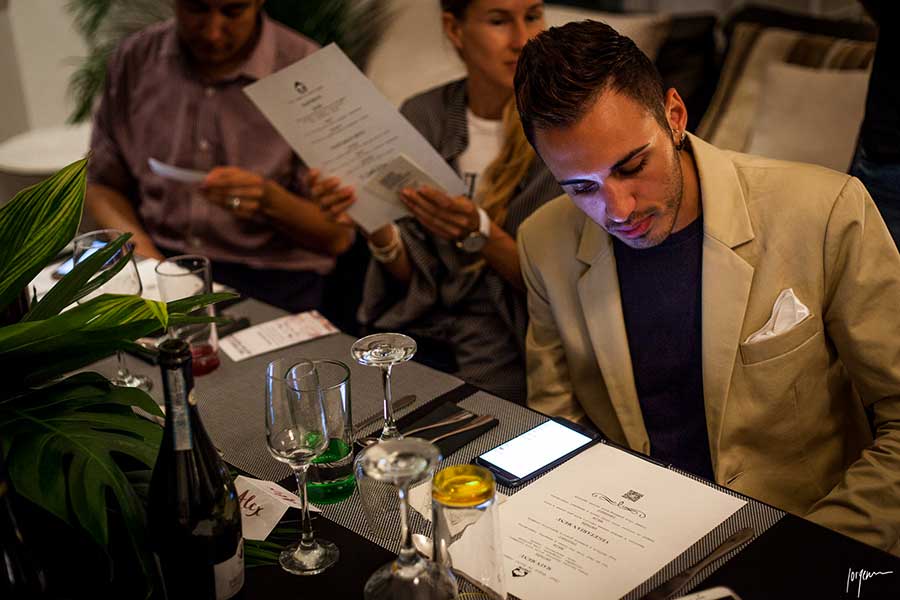
A Michelin star chef begins menu design with the guests and the occasion, not with a favourite dish. Before a single ingredient is chosen, the chef establishes how many people are dining, how long the evening should run, and what is off the table — allergens, dietary needs, strong preferences.
That brief shapes everything downstream. An anniversary dinner for two has a different rhythm and length from a birthday for twelve, even when the cuisine overlaps. A menu built for one context and dropped into another is where DIY attempts and AI-generated menus most often come undone: the dishes may be sound, but the shape of the night is wrong.
This is also the quiet advantage a private chef or restaurant chef holds over a downloaded recipe. The menu is composed for a specific table on a specific night, so dietary restrictions and preferences are designed in from the start rather than worked around at the last minute.
Build the arc: light to rich, with room to breathe
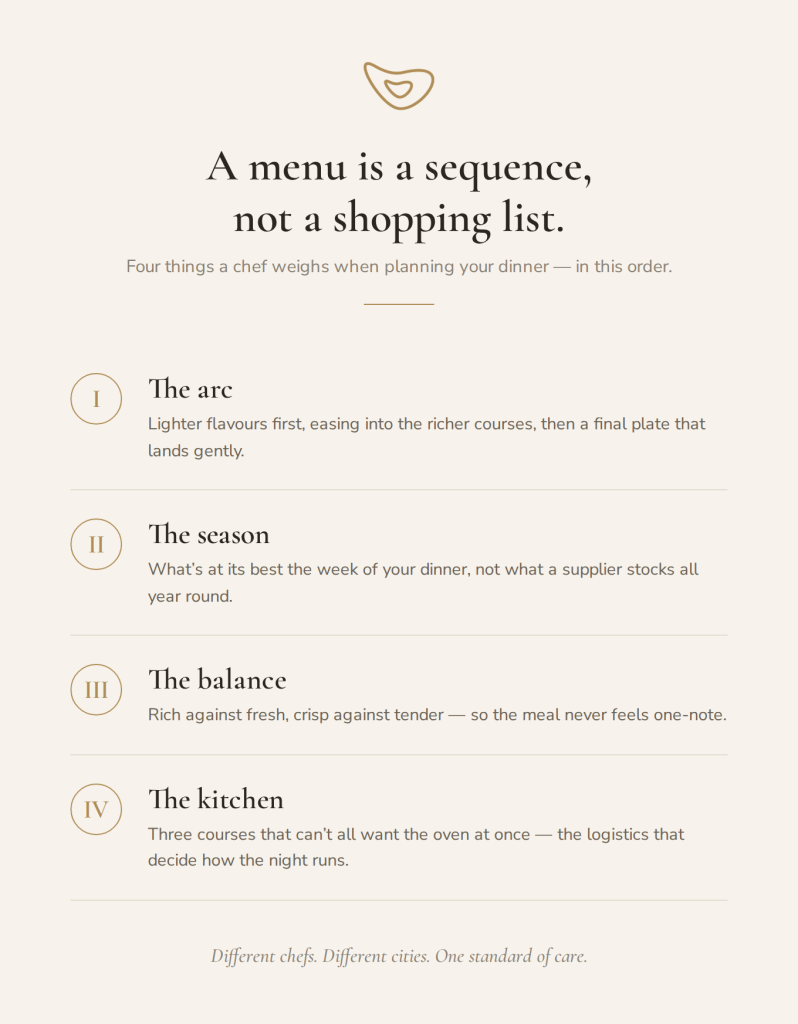
The arc of a Michelin-standard menu moves from light and fresh through complex and rich, then resolves — the widely used progression is light, complex, rich, fresh, sweet. This rising flavor curve is deliberate, and it is closer to psychology than to cooking: guests who travel a well-paced curve feel they have completed a genuine culinary journey rather than eaten a sequence of unrelated plates.
The opening course wakes the palate without overwhelming it — small, bright and precise, often built on vegetables, fish or shellfish. Richer courses follow, with the heaviest plate anchored deliberately rather than dropped in early. One tasting-menu analysis found that menus placing a heavy protein course before the midpoint drew notably more guest complaints about heaviness, while those positioning the main protein around the middle of a six-to-eight-course sequence reported fewer palate-fatigue comments. Position, not just quality, decides how a dish lands.
Rest points matter as much as showpieces. A palate cleanser — a sorbet, something sharp and cold — resets the mouth after the richest course so the next one registers. Professional chefs also resist the urge to make every course a showpiece; a menu where every plate shouts leaves nowhere for the meal to breathe, and guests remember the exhaustion more than any single dish.
Cook the season: why timing beats availability
Michelin star chefs design menus around what is at its seasonal best, not around what a supplier can deliver year-round. Seasonality is a defining marker of fine dining: tasting menus typically change several times a year, tracking the seasons so that produce reaches the table at its peak rather than out of a cold store.
The reason is simple. An ingredient picked in season, close to when it is served, carries flavor that the same ingredient shipped and stored out of season cannot match. Designing to the season is what makes a menu taste of a particular place and a particular week, instead of tasting like it could have come from anywhere at any time.
Ingredients commonly found on Michelin-starred menus reflect this same logic: exceptional raw materials, chosen for quality and season rather than luxury for its own sake. Premium proteins and seafood — cuts of beef and lamb, poultry, and shellfish such as crab — sit alongside peak-season vegetables, mushrooms and fresh herbs, with sauces and stocks built from scratch to tie a dish together. Luxury items like truffle, caviar or foie gras appear at the top end, but the defining marker is not the price of an ingredient; it is whether it is the best available example of itself that week. A perfectly ripe seasonal vegetable, sourced with intention, meets Michelin’s quality-of-ingredients criterion as squarely as any luxury product.
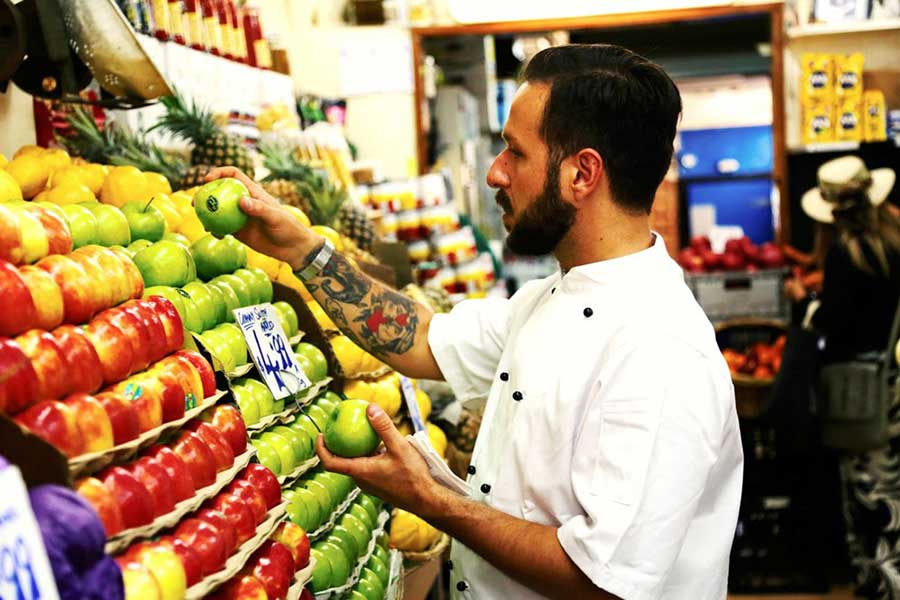
For anyone building a menu, this is the hardest part to fake. A recipe found online has no idea what is peaking the week of the dinner or where the diner lives. A chef starts there — often at local markets and specialist suppliers — and lets what is genuinely good that week shape the courses.
Balance the plate: flavor, texture and contrast
Balance in menu design means setting rich against fresh, crisp against tender and one flavor profile against another, so no two courses pull in the same direction. A meal where every dish leans rich and creamy feels flat by the third course, even when each plate is excellent on its own. Contrast is what keeps the palate interested from the opening bite to the last.
That balance operates within a plate and across the whole menu. Within a course, a chef weighs textures and temperatures — something crisp against something soft, something warm against something cool. Across the menu, courses alternate to maintain a rhythm, excitement giving way to calm and back again, so the sequence never becomes monotonous.
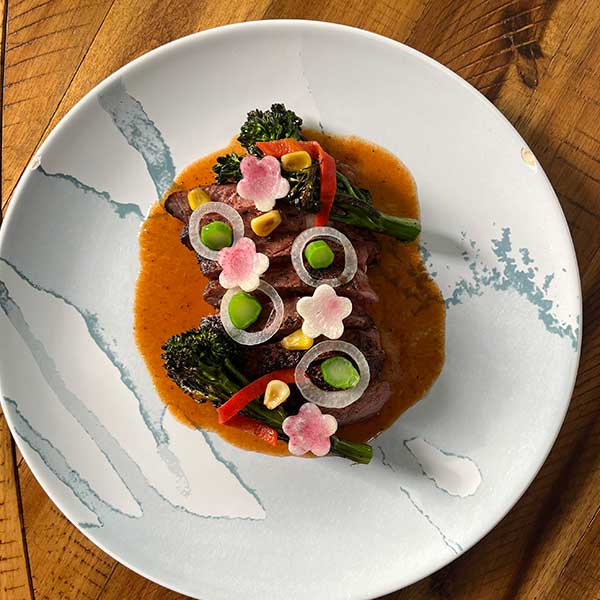
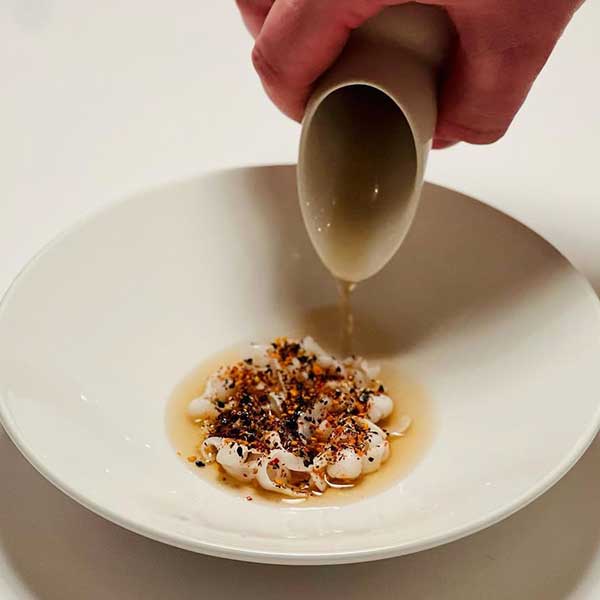
Color and presentation follow the same logic. Plating at this level uses contrast and restraint — clean space on the plate, considered use of color, height and layering — because a dish is judged by eye before it is tasted. Presentation is not decoration bolted on at the end; it is part of how the course is composed.
How to present food like a Michelin star chef
Presenting food like a Michelin star chef means treating the plate as a composition — controlled portions, deliberate negative space, and contrast in color, height and texture — so the dish is judged and enjoyed by eye before the first bite. Presentation is one expression of technique, which is itself one of Michelin’s five criteria; it is not decoration added at the end.
A few principles carry most of the effect. Restraint comes first: smaller, precise portions with clean space around them read as considered, where a crowded plate reads as busy. Contrast does the visual work — a bright element against a muted one, something tall against something flat, a crisp component against a smooth purée or sauce. Placement is intentional rather than symmetrical, often using odd numbers and off-center focal points to draw the eye. And the garnish earns its place: every element on the plate should be edible and there for a reason, reinforcing the dish rather than dressing it up.
Presentation also serves the menu’s arc. A visually light, bright opening plate signals the meal ahead; a richer main is plated with more weight and depth. Seen across the whole sequence, plating is another tool for pacing — part of how a chef composes the night, not a finishing flourish.
Engineer the kitchen: the logistics that decide the night
The final layer of Michelin menu design is operational: whether the menu can actually be cooked and plated, in this kitchen, for this many people, on time. A menu that ignores the kitchen is where beautiful plans collapse — three courses that all need the oven at the same moment, or a plate that looks effortless but takes forty minutes to send out for a full table.
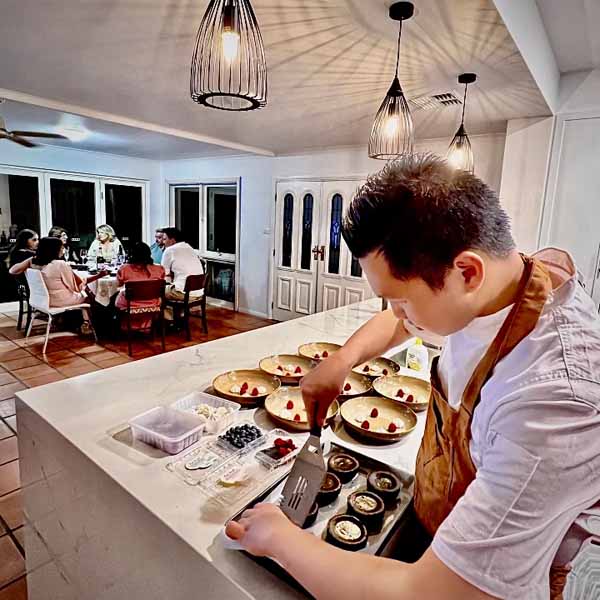
Professional chefs design against these constraints from the start. Courses are sequenced so the kitchen is never overloaded at one moment, and dishes are chosen partly for whether they can be plated cleanly at scale without losing quality. A common failure among first attempts is designing six or eight individually exciting dishes, then discovering mid-service that the meal is impossible to plate on time.
Costing sits in the same layer. A skilled chef designs for efficiency as well as flavor — using one cut of beef for a steak course and its trimmings for stock, so a dish impresses while the kitchen stays cost-efficient. Menu pricing in a restaurant flows from the same discipline: a well-designed menu controls food costs without cutting quality. Invisible to the guest, it is a large part of what separates a professional menu from an ambitious home experiment, and it is precisely the part no recipe list or chatbot accounts for.
Why hiring a chef beats doing it yourself
For a dinner that has to land — a milestone, a celebration, an occasion that matters — a professional chef removes the two things most likely to go wrong: a menu that ignores the kitchen, and a sequence that ignores the guests. The value is not only in the cooking. It is in the design decisions made before anyone turns on a burner: the arc, the seasonality, the balance and the logistics, all resolved in advance and composed for one specific table.
That is the case for booking a private chef over recreating a Michelin experience solo. The dishes are the visible part. The sequence, quietly engineered around the night, is what guests actually remember.
Frequently asked questions
Who holds the most Michelin stars?
The late French chef Joël Robuchon holds the all-time record, having accumulated more than 30 Michelin stars across his restaurants worldwide over his career and peaking at 32 at once. Among living chefs, Alain Ducasse is the most decorated, with around 21 stars earned across his career and multiple three-star restaurants in different countries.
What are the criteria for earning a Michelin star?
Michelin awards stars on five criteria: the quality of the ingredients, mastery of flavor and cooking techniques, harmony of flavors, the personality of the chef expressed through the cuisine, and consistency across the menu and between visits. Stars are given to the restaurant rather than the individual chef and are reassessed every year, so the standard has to be met on every plate, every service.
What ingredients are commonly used in Michelin-starred menus?
Michelin-starred menus are built on exceptional, seasonal ingredients rather than luxury alone: premium proteins and seafood, peak-season vegetables, mushrooms and fresh herbs, and scratch-made sauces and stocks. High-end items such as truffle, caviar and foie gras feature at the top end, but what matters most is that each ingredient is the best available example of itself for that season.
What does it mean to build a menu like a Michelin star chef?
It means designing a menu as a deliberate sequence of courses built around the guests, the season and the kitchen, rather than choosing dishes in isolation. The chef fixes the structure first — how the night should flow, which course anchors the meal, what is in season — and selects specific dishes to fit that structure.
How many courses should a fine dining menu have?
There is no fixed number; Michelin-style tasting menus commonly run anywhere from four to more than a dozen courses. Portion sizes are reduced as the course count rises so diners finish satisfied rather than overly full. The right length depends on the occasion and how long the evening should run.
What order do courses go in on a tasting menu?
The widely used progression moves from light to complex to rich, then to fresh and finally sweet, with a palate cleanser to reset between the richest courses. Lighter, brighter dishes open the meal, the heaviest course is anchored around the middle rather than early, and the sequence resolves gently into dessert. A chef may also pair each course with a matching wine to reinforce the arc.
Why do Michelin restaurants change their menus by season?
Because ingredients taste best in season, and designing around seasonal produce is a core marker of fine dining. Tasting menus typically change several times a year so that what reaches the table is at its peak, which also gives the menu a sense of a specific time and place.
Can I build a Michelin-standard menu at home myself?
The dishes can be attempted at home, but the harder part is the design: sequencing courses so flavors build correctly, matching them to what is genuinely in season, balancing textures across the meal, and making sure everything can be cooked and plated on time in one kitchen. This menu-design layer — not any single recipe — is what a professional chef adds.
What is the difference between a menu and a list of dishes?
A list of dishes is a set of standalone recipes; a menu is a planned sequence where each course is chosen in relation to the others and to the night as a whole. The difference shows up in how the meal is experienced — a true menu builds, rests and resolves, while a list simply serves one plate after another.
Sources
The key factual claims in this article — the five Michelin award criteria and the records for the most Michelin stars held — are drawn from the sources below.